7 août 2025
Sustainable Eggs
Carlos Van Mieghem

Published
Nest June, 2025Author
Carlos Van MieghemShare


In recent years, doctors and dietitians have come to realize that eggs are in fact healthy.
But not all eggs are created equal. Poultry farmer Guido Sterkendries knows all about it. Carlos Van Mieghem, cardiologist and professor at KU Leuven, explains: “For years, eggs were blamed as a cause of heart disease, even though we now know there is hardly a connection between heart issues and eating cholesterol-rich foods like eggs. The cholesterol we take in through our diet is largely excreted through our stool. Most of the cholesterol in our bloodstream is actually produced by our own cells.”
In the U.S., this insight has already been incorporated into official dietary guidelines. Based on what we know today, even daily consumption of up to six eggs is considered acceptable.
There’s more. For years, elderly people were warned that eggs would harm brain function because of cholesterol. But the opposite is true. Two nutrients found abundantly in eggs—lecithin and choline—are essential for healthy brain function. Eggs are also rich in lutein, which is important for the retina and helps protect against a common form of age-related blindness, according to Professor Van Mieghem.
Studies have even looked into the best way to prepare an egg. The healthiest method? Soft-boiled, with firm egg white and a runny yolk. If the yolk is too liquid, your body has a harder time absorbing the nutrients. And the trend of eating only egg whites actually reduces this absorption. For diabetics, studies even suggest that eating only egg whites—without the yolk—may be worse.
Still, as Professor Van Mieghem notes, not all eggs are equal. Enter Guido Sterkendries. Once a world-renowned wildlife photographer—known for capturing images of rare species like the golden frog in Panama—he travelled through remote regions of South America and met some of the most isolated tribes.
Today, he raises chickens on an old farm in Oedelem. His journey started thirteen years ago after a burnout. “I was put on a diet that banned almost everything I loved, including eggs. That didn’t go well—lack of protein left me feeling weak. It made me wonder: are all eggs really bad? I thought back to my time with the Tapirapé people in Brazil. There, I ate eggs from chickens that roamed freely and didn’t eat grains or soy. Wild chickens mostly eat insects. Those eggs were incredibly tasty and nutritious.”
So Guido started raising chickens, first in Edegem, where they wandered through his garden and slept in the garage—until that became unmanageable. “That’s why I eventually settled here in Oedelem. Today, I keep about 400 chickens on the farm. Their feed is based on how poultry farmers worked a century ago: a mix of wet and dry feed. I’ve created moist areas in the garden that attract insects, which the chickens are free to eat.”
The dry feed—and more recently, chick mash—is made entirely to his specifications by the De Brabandere company in Wingene. It’s sold under the brand name ‘Guido’s Happy Chicks.’ He also repurposes food waste into chicken feed, offering a sustainable answer to one of the great environmental challenges of our time.
What a chicken eats ends up in the egg. Lab tests showed my eggs contain a third more vitamin A and no less than twenty times more healthy omega-3 fats.”
That’s what drives Guido. He’s seen firsthand the destruction caused by deforestation in the Amazon and the exploitation of Brazil’s Cerrado region—land now used to grow massive amounts of soy, which ends up in chicken feed here in Europe, simply because soy is protein-rich. Flemish Minister of Agriculture Jo Brouns has recently taken steps to reduce imports from these endangered areas.
Guido’s chickens eat zero soy. “What you feed a chicken ends up in the egg,” he says. He had his eggs tested in a specialized lab. The results? A third more vitamin A than the average egg—including organic ones—and an astounding twenty times more beneficial omega-3 fatty acids.
He has 400 chickens. Most poultry farmers have tens of thousands. So is it sustainable? “I won’t get rich doing this, but I aim to make a living. I know not every farmer can work this way, and not everyone is willing to pay the price I ask – but I want to show there’s an alternative, and that it’s viable. I believe in charging a fair price for a fair product. Some people call this ‘niche,’ but I want to inspire. What’s niche today could be mainstream tomorrow.”
How does he sell his eggs, which are significantly more expensive than supermarket ones? “Through specialty delicatessens, where customers appreciate both the taste and the nutritional value. Some of Belgium’s top chefs also believe in the project – people like Peter Van den Bossche of Brasserie Latem, Tim Boury of the three-star Boury restaurant, and Frederiek Vandenbussche of La Maison du Terroir.”
Guido also set up a shareholder group: people who buy a share and get discounted eggs in return. “They do it partly for the products, but also to support what I stand for.”
We get to taste the eggs. The yolks are deep yellow, the flavor rich and creamy—clearly superior to store-bought varieties. But Guido has one more surprise. He recently started making advocaat (egg liqueur) with his eggs, called “De Lepelaer”—based on jenever and enriched with real vanilla. He spreads a thick golden dollop onto a warm pancake. It’s more a luxurious cream than a drink—and by far the best advocaat we’ve ever tasted. The higher price is worth every cent. Raising eggs this way is better for the planet—and undeniably better for the palate.
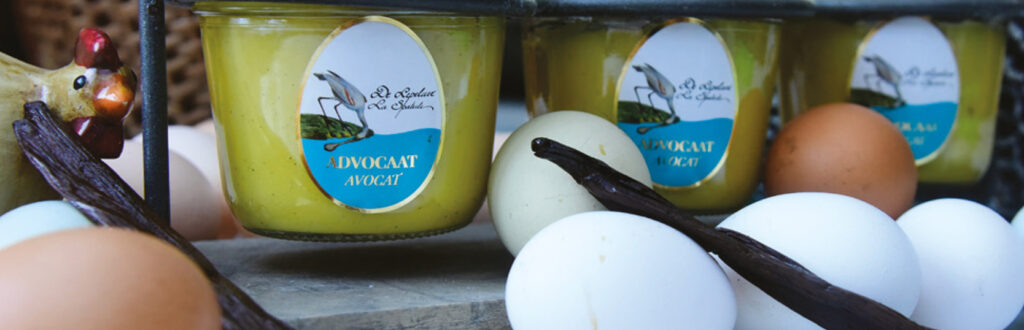
The eggs, advocaat, and chicken meat are available at various specialty stores in Edegem, Mortsel, Bruges, Damme, and Knokke.
Guido also sells directly from the farm by appointment:
Bosstraat 4, 8730 Oedelem
T: 050-66 94 18 or 0472-57 48 78
Find him on Facebook under ‘Guido Sterkendries’
Share